Cone beam imaging in Southaven, MS provides detailed 3D views of your teeth, jaws, and facial structures. At Desoto Dentures and Implants, this technology supports precise diagnosis and treatment planning for dental implants, extractions, root canal therapy, impacted teeth, and jaw joint concerns.
Cone Beam Imaging Explained
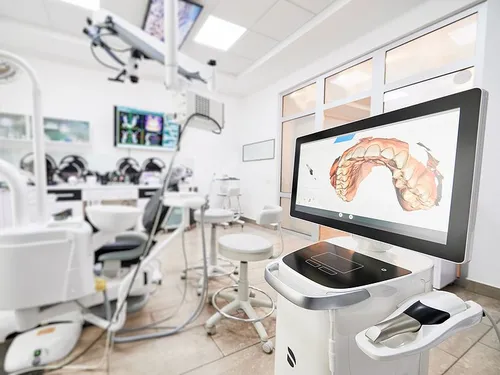
Cone beam computed tomography (CBCT) is a type of dental 3D imaging that uses a cone-shaped X-ray beam to capture hundreds of images in seconds. Specialized software reconstructs those images into a high-resolution 3D model of your mouth and jaws.
Dental CBCT delivers more information than panoramic or bitewing X-rays and typically uses a lower dose than a medical CT scan of the same area.
How Cone Beam Imaging Can Help You
- Provides accurate 3D views for implant planning, including bone height, width, and density.
- Maps nerve canals and sinus locations to reduce surgical risks.
- Shows hidden tooth anatomy for endodontic treatment, helping locate extra canals and fractures.
- Assesses impacted teeth, jaw cysts, and pathology with clarity not possible on standard X-rays.
- Evaluates the temporomandibular joints (TMJ) and airway when indicated.
- Enables targeted treatment and fewer surprises during procedures.
How A Cone Beam CT Works
A CBCT unit has a rotating arm that moves around your head, capturing images from many angles. You will stand or sit upright while the machine rotates 180–360 degrees. The scan itself usually takes less than one minute, and the entire appointment often lasts about 10–15 minutes. The resulting dataset is processed into 3D images that dentist can view from any angle or slice into thin cross-sections for detailed analysis.
Before And After: What To Expect
Before imaging, expect a brief screening and positioning. Wear comfortable clothing and remove glasses, earrings, hairpins, or removable dental appliances. Inform the team if you may be pregnant.
During the scan, you should not feel anything; the machine is open and does not enclose your head. Afterward, dentist uses the 3D dataset to plan treatment steps, simulate implant placement, measure bone, and identify vital structures.
Common Reasons dentist May Order CBCT
- Dental implant planning and cone beam scan for implants.
- Evaluating jawbone loss before dentures or grafting procedures.
- Investigating cracked teeth, root resorption, or failed root canals.
- Assessing impacted teeth, cysts, lesions, and sinus issues related to dental infections.
- Comparing CBCT vs. traditional X-rays when 3D detail will change the treatment approach.
FAQs
Hours